Harmandir Sahib
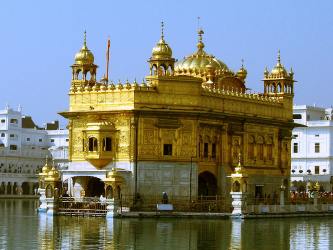
The Harmandir Sahib also known as Darbar Sahib and informally referred to as
the "Golden Temple", is a prominent Sikh Gurdwara located in the city of
Amritsar, Punjab, India. It was built by the fifth Sikh guru, Guru Arjan, in
the 16th Century. In 1604, Guru Arjun completed the Adi Granth, the holy
scripture of Sikhism, and installed it in the Gurdwara.
There are four doors to get into the Harmandir Sahib, which symbolize the
openness of the Sikhs towards all people and religions. The present day
Gurdwara was rebuilt in 1764 by Jassa Singh Ahluwalia with the help of other
Sikh Misls. In the early nineteenth century, Maharaja Ranjit Singh secured
the Punjab region from outside attack and covered the upper floors of the
Gurdwara with gold, which gives it its distinctive appearance and its
English name.
The Harimandir Sahib is considered holy by Sikhs. The holiest text of
Sikhism, the Guru Granth Sahib, is always present inside the Gurdwara. Its
construction was mainly intended to build a place of worship for men and
women from all walks of life and all religions to come and worship God
equally. Over 100,000 people visit the holy shrine daily for worship.
History
The Harmandir Sahib literally means The Temple of God. The fourth guru of
Sikhism, Guru Ram Das, excavated a tank in 1577 CE which subsequently became
known as Amritsar (meaning "Pool of the Nectar of Immortality"), giving its
name to the city that grew around it. In due course, a Sikh edifice, Sri
Harmandir Sahib (meaning "the abode of God"), rose in the middle of this
tank and became the supreme centre of Sikhism. Its sanctum came to house the
Adi Granth comprising compositions of Sikh Gurus and other saints considered
to have Sikh values and philosophies, e.g., Baba Farid, and Kabir. The
compilation of The Adi Granth was started by the fifth guru of Sikhism, Guru
Arjan.
Construction of the Harmandir Sahib
Guru Arjan Sahib, the Fifth Sikh Guru, conceived the idea of creating a
central place of worship for the Sikhs and he himself designed the
architecture of Sri Harmandir Sahib. Earlier the planning to excavate the
holy tank (Amritsar or Amrit Sarovar ) was chalked out by Guru Amar Das Ji,
the Third Sikh Guru, but it was executed by Guru Ramdas Sahib under the
supervision of Baba Budha ji. The land for the site was acquired by the
earlier Guru Sahibs on payment or free of cost from the Zamindars
(landlords) of native villages. The plan to establish a town settlement was
also made. Therefore, the construction work on the Sarovar (the tank) and
the town started simultaneously in 1570. The work on both projects completed
in 1577 A.D. During the leadership of the fifth Guru, Guru Arjan
(1581–1606), the full-fledged Gurdwara was built. In December 1588, Guru
Arjan initiated the construction of the Gurdwara. The foundation stone was
laid by none other than Guru Arjan Sahib himself in December 1588. It is a
common misconception that the foundation stone was laid by the Sufi saint
Mian Mir of Lahore.
Some of the architectural features of the Harmandir Sahib were intended to
be symbolic of the Sikh worldview. Instead of the normal custom of building
a Gurdwara on high land, it was built at a lower level than the surrounding
land so that devotees would have to go down steps to enter it. In addition,
instead of one entrance, Sri Harmandir Sahib has four entrances.
The Gurdwara was completed in 1604. Guru Arjan, installed the Guru Granth
Sahib in it and appointed Baba Buddha as the first Granthi (reader) of it on
August 1604. In the mid-18th century it was attacked by the Afghans, by one
of Ahmed Shah Abdali's generals, Jahan Khan, and had to be substantially
rebuilt in the 1760s. However, in response a Sikh Army was sent to hunt down
the Afghan force. Both forces met each other five miles outside Amritsar;
Jahan Khan's army was destroyed.
Harmandir Sahib Complex and Its Vicinity
The Gurdwara is surrounded by a large lake or holy tank, known as the
Sarovar, which consists of Amrit ("holy water" or "immortal nectar"). There
are four entrances to the Gurdwara, signifying the importance of acceptance
and openness.
Inside the Gurdwara complex there are many shrines to past Sikh Gurus,
saints and martyrs (see map). There are three holy trees (bers), each
signifying a historical event or Sikh saint.
Inside the Gurdwara there are many memorial plaques that commemorate past
Sikh historical events, saints, martyrs and includes commemorative
inscriptions of all the Sikh soldiers who died fighting in World Wars I and
II.
In keeping with the rule observed at all Sikh Gurdwaras worldwide, the
Harmandir Sahib is open to all persons regardless of their religion, colour,
creed, or sex. The only restrictions on the Harmandir Sahib's visitors
concern their behavior when entering and while visiting.
First-time visitors are advised to begin their visit at the information
office and then proceed to the Central Sikh Museum near the main entrance
and clock tower.
The Harimandir Sahib runs one of the largest free kitchens in the world,
serving 100,000 people on average daily. The meal consists of flat bread and
lentil soup.
Artwork and Monument Sculptures
Much of the present decorative gilding and marblework dates from the early
19th century. All the gold and exquisite marble work were conducted under
the patronage of Hukam Singh Chimni and Emperor Ranjit Singh, Maharaja of
the Sikh Empire of the Punjab. The Darshani Deorhi Arch stands at the
beginning of the causeway to the Harmandir Sahib; it is 62 metres (203 ft)
high and 6 metres (20 ft) in width. The gold plating on the Harmandir Sahib
was begun by Ranjit Singh and was finished in 1830. Maharaja Ranjit Singh
was a major donor of wealth and materials for the shrine and is remembered
with much affection by the Punjabi people in general and the Sikh community
in particular.
Celebrations at the Harmandir Sahib
One of the most important festivals is Vaisakhi, which is celebrated in the
second week of April (usually the 13th). Sikhs celebrate the founding of the
Khalsa on this day and it is celebrated with fervour in the Harmandir Sahib.
Other important Sikh religious days such as the martyrdom day of Guru Teg
Bahadur, the birthday of Guru Nanak, etc., are also celebrated with
religious piety. Similarly Bandi Chhor Divas is one of the festivals which
sees the Harmandir Sahib beautifully illuminated with Divas (lamps); lights
and fireworks are discharged. Most Sikhs visit Amritsar and the Harmandir
Sahib at least once during their lifetime, particularly and mostly during
special occasions in their life such as birthdays, marriages, childbirth,
etc.
Operation Blue Star
Operation Blue Star was undertaken on 3 June 1984 and ended on 6 June 1984.
The Indian Army, led by General Kuldip Singh Brar, brought infantry,
artillery, and tanks into the Harmandir Sahib to put a stop to Dharam Yudh
Morcha. During these "Morchay" thousands of Sikhs courted arrest. Indira
Gandhi ordered the army to launch Operation Blue Star. Within six months,
Indira Gandhi’s Sikh bodyguards killed her (31 October 1984) for the
perceived sacrilege.
Fierce fighting ensued between Sikhs and the soldiers, in which many of the
Sikhs were killed along with many soldiers. The Harmandir Sahib complex also
suffered much damage due to the attack, especially the holy Akal Takhat
Sahib.
This attack is regarded by Sikhs as a desecration of Sikhism's holiest
shrine and discrimination against a minority in India. In 1986, the repairs
performed on the Akal Takhat Sahib after the attack, which the Rajiv Gandhi
Government had undertaken without consultation, were removed. A new Akal
Takhat Sahib was completed in 1999 by Kar Sevaks (volunteer labor and
funding).
Best Time
Best time to visit Amritsar is in the winter, between October and March.
Getting There
Nearest airport is Sri Guru Ram
Das Jee International Airport, located about 11 kilometres (7 mi)
northwest of the city of Amritsar.
undo ...back