Panchakki
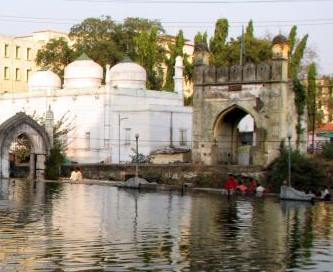
Panchakki, also known as the water mill, takes its name from the mill which
used to grind grain for the pilgrims. This monument located in Aurangabad,
Maharastra, displays the scientific thought process put in medieval Indian
architecture. It was designed to generate energy via water brought down from
a spring on a mountain. The building, attached to the dargah of Baba Shah
Musafir a Sufi saint is located in a garden near the Mahmud Darvaza and
consist of a mosque, a madrissa, a kacheri, a minister's house, a sarai and
houses for zananas.
History
Most of the buildings in the dargah complex (including Panchakki) were
erected by Turktaz Khan, a noble on the staff of Nizam-ul-Mulk Asaf Jah in
about 1695 A. D.
The oblong reservoir in front of the mosque and fountains were added 20
years later by Jamil Beg Khan. Dating back to the 17th century, this
ingenious water mill was designed to use the energy generated by flowing
water from a nearby spring to turn the large grinding stones of the flour
mill. Shah Mosafar died in Hijri 1110. This water mill was used to grind
grain for the pilgrims and disciples of saints as well as for the troops of
the garrison.
Operation
The water-mill is kept fed with sufficient water by an underground conduit,
which commences from a well just above the junction of the Harsul river with
a tributary stream eight kilometers away. After crossing the tributary
stream near its confluence with Harsul, this water-pipe proceeds to the
Panchakki reservoir. The arrangement is such that the water is made to fall
into the Panchakki cistern from quite a height in order to generate the
necessary power to drive the mill. The cistern lies in front of the mosque
whose bottom forms the roof of a spacious hall. The cool chambers of the
hall are used in summers by pilgrims, and is about 164' X 31' ornamented
with fountains. The excess of water is let in the Kham river.
A fine view of the Kham river can be had from the windows of this hall.
There is also a cenotaph to the spiritual preceptor of Baba Musafir Shah and
a tomb to his disciple Baba Shah Mahmood and a few other graves. A huge
banyan tree on the southern margin of the reservoir provides shade and adds
beauty to the whole scene. In the North-West corner, adjacent to the
cistern, is the water mill driven entirely by water power. It is said that
in the olden days, grain could be ground without physical effort.
The country here exhibits one of the most picturesque landscapes about
Aurangabad. The Kaula nala skirts the garden, and is first crossed by an old
bridge with pointed arches and then by a second bridge which spans it lower
down. The walls of Begampura are to the right and the city walls are to the
left, while Shah Musafir's garden is between the latter and the river bank.
The garden walls descend down to the bed of the nala; and the dargah and the
accompanying buildings, with the cisterns and the fountains that are
interspersed, blend picturesquely with the garden vegetation.
Getting There
Panchakki is located about 3 kilometers from the city center, so the journey
should take around 10-15 minutes by car or rickshaw and slightly longer by
bus. Once you reach the complex, you can explore the museum and the
surrounding gardens on foot.
undo ...back